Fewer Checks, Fewer Fines, Lower Compliance.
Victorian fisheries inspections and enforcement, 2018-19 to 2025-26
Victorian Fisheries Protection Alliance Incorporated (VFPAI) · November 2026
At a glance
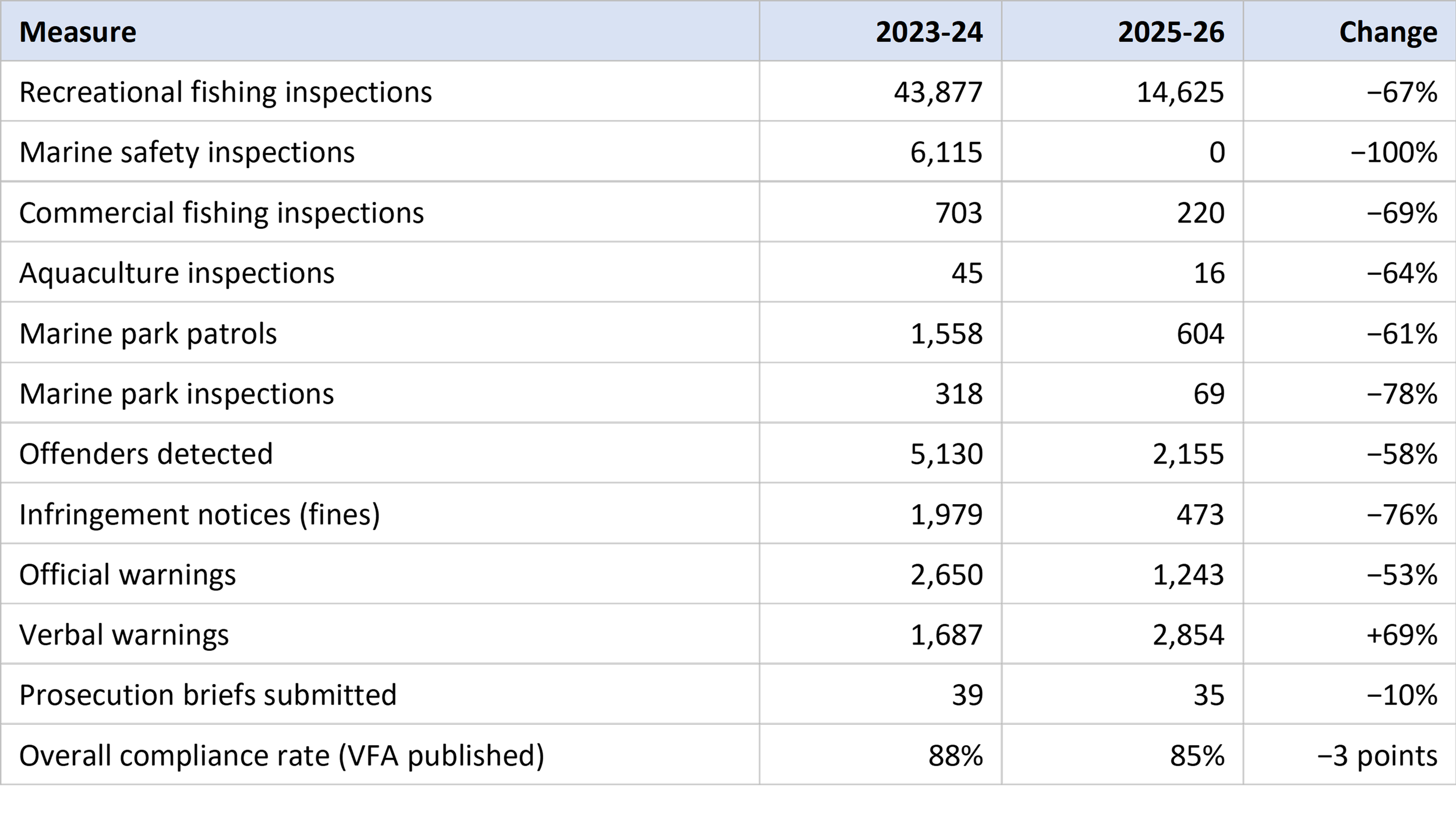
The Victorian Fisheries Authority (VFA) publishes its own inspection and enforcement figures each year. We have charted eight years of those figures. They show what has happened since Fisheries Officer numbers were cut from 73 to 39, and the Altona, Braeside and Bendigo stations were closed.
• Inspections have collapsed. Recreational fishing inspections are down 67% on 2023-24, and commercial fishing inspections are down 69%.
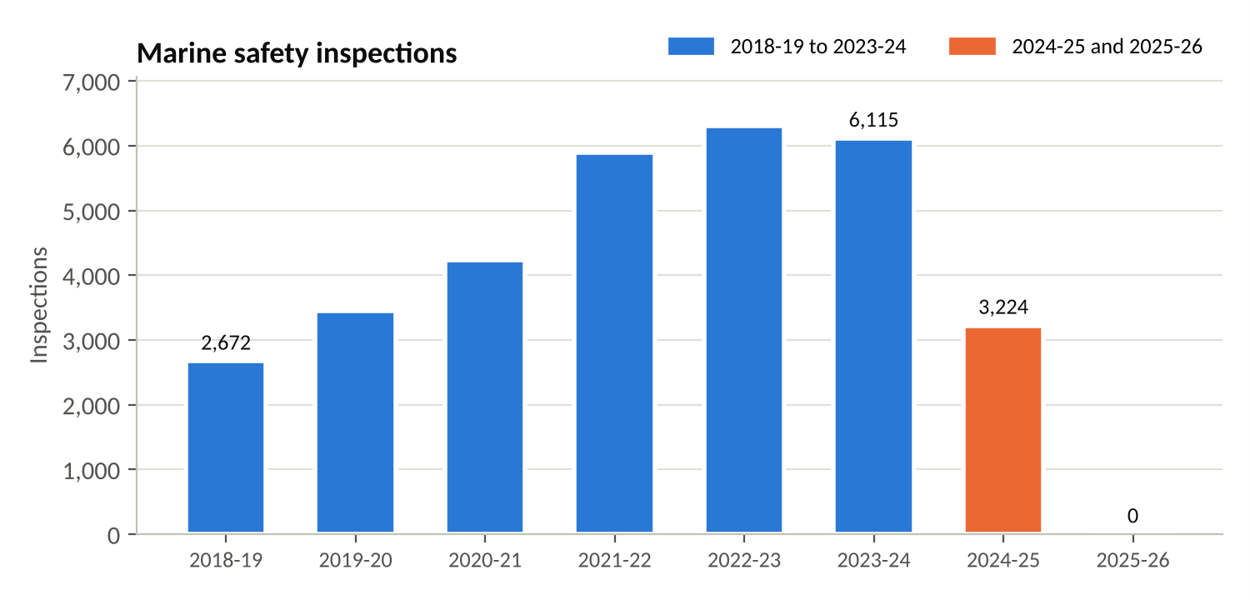
• Marine safety inspections have stopped. More than 6,000 were carried out in 2023-24. There were none in 2025-26.
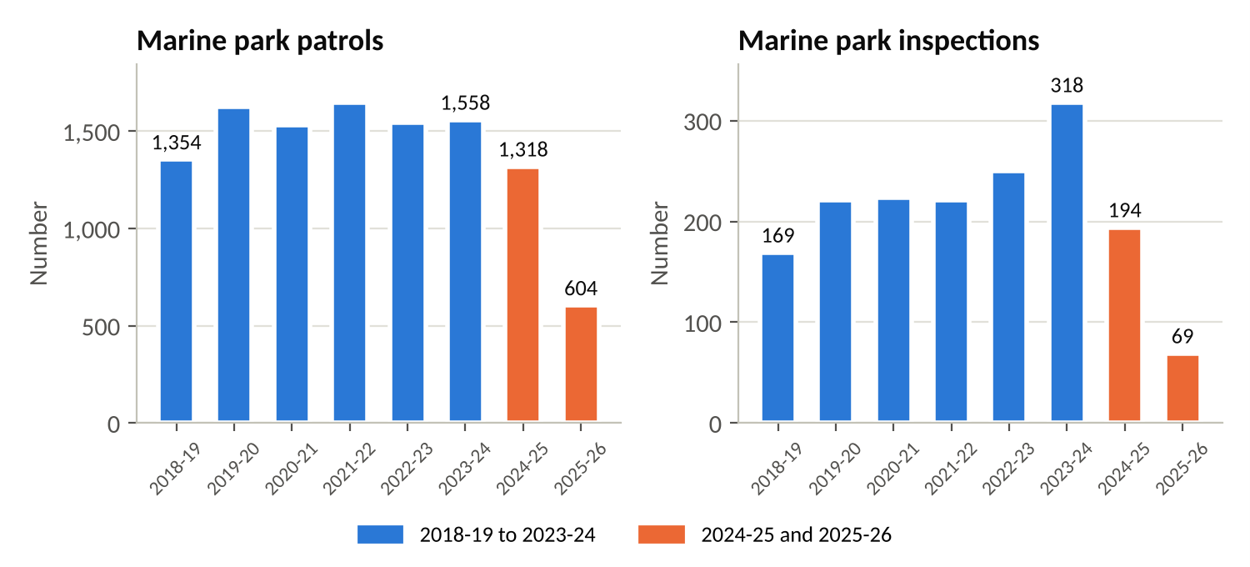
• Marine parks are patrolled far less. Patrols are down 61% and marine park inspections are down 78%.
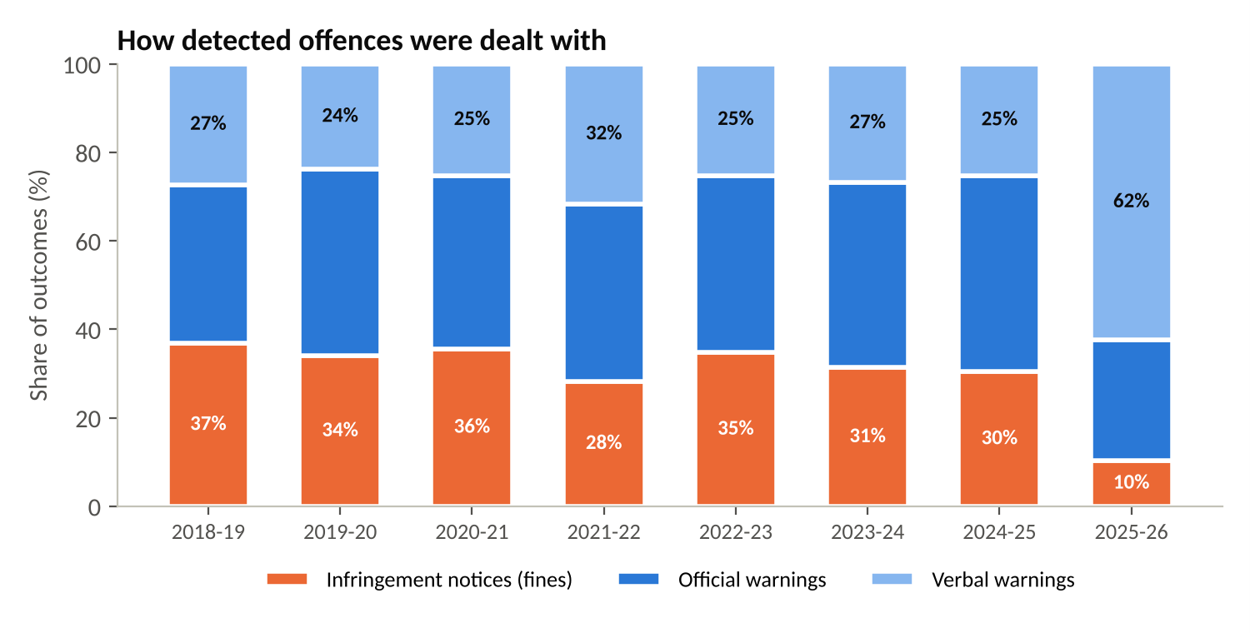
• Fewer fines are being issued. Infringement notices are down 76%. Fines fell from about a third of enforcement outcomes to one in ten, while verbal warnings rose to more than 60%.
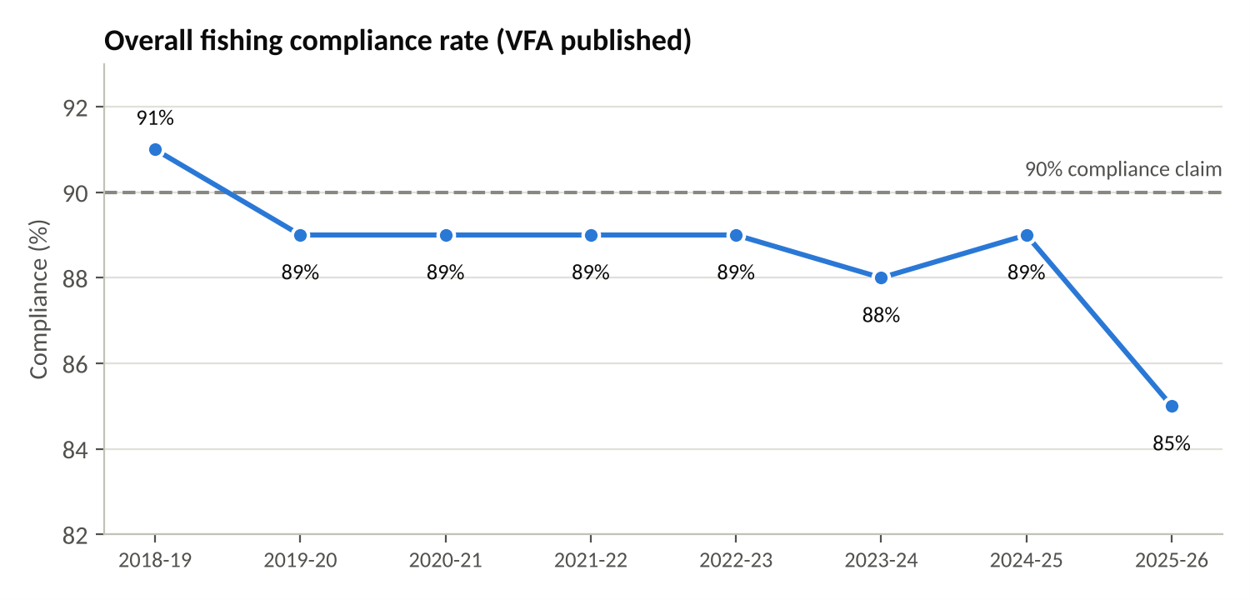
• Compliance is getting worse. On the VFA’s own figures, compliance fell to 85% in 2025-26. It has not been above 90% since 2018-19.
How the figures changed, 2023-24 to 2025-26
1. Inspections
Recreational fishing.
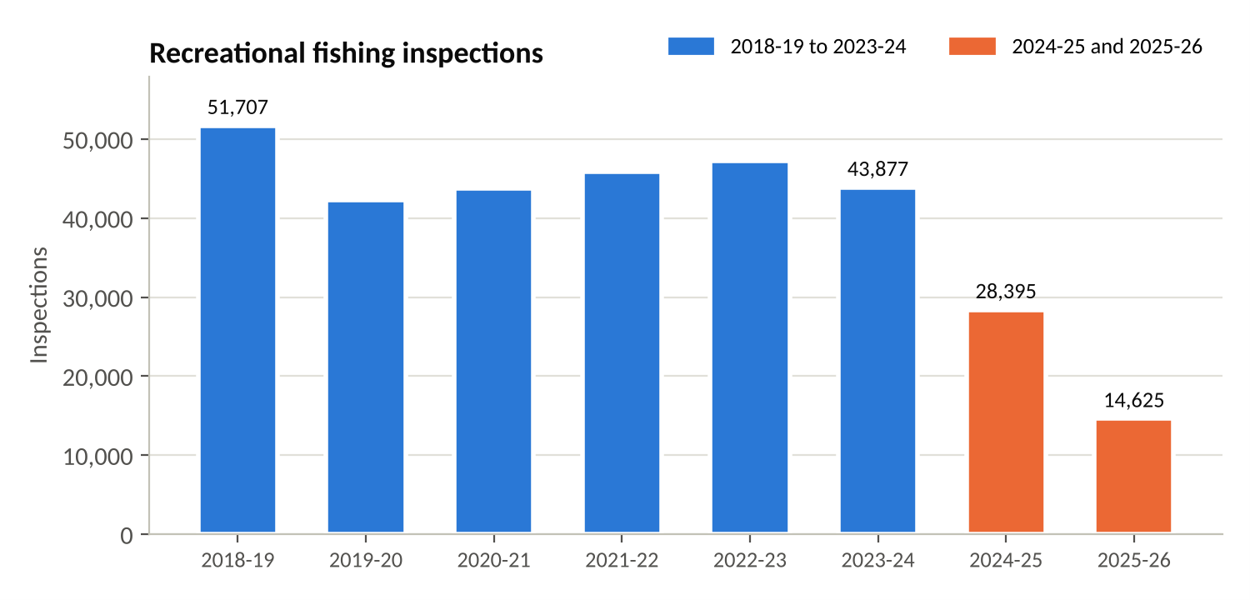
For six years the VFA carried out between about 42,000 and 52,000 recreational fishing inspections a year. In 2024-25 inspections fell by 35%, and in 2025-26 they almost halved again, to 14,625. That is around 29,000 fewer checks a year than in 2023-24.
Two out of every three recreational fishing inspections have disappeared in two years.
Marine safety
Marine safety inspections were a growing part of Fisheries Officers’ work. They more than doubled, from 2,672 in 2018-19 to a peak of 6,310 in 2022-23, and were still above 6,000 in 2023-24. They then halved in 2024-25 and stopped completely in 2025-26.
A growing workload was not reduced. It was dropped altogether.
Commercial fishing and aquaculture
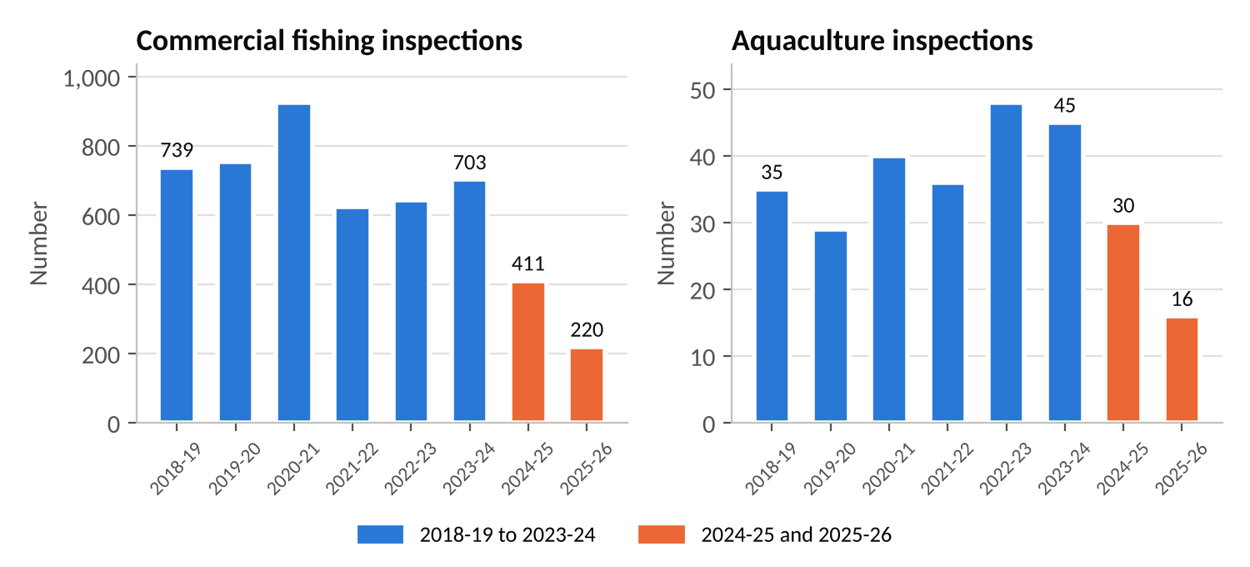
Commercial fishing inspections ranged from about 625 to 926 a year before falling to 411 and then 220, down 69% on 2023-24. The Government points to the closure of the 700-tonne commercial net fishery. However, the fall began at the same time as the falls in every other category. Aquaculture inspections are small in number but follow the same pattern, falling from 45 to 16.
2. Marine parks and sanctuaries
The VFA is the lead agency for enforcing fishing bans in Victoria’s marine protected areas. Marine park patrols held steady at around 1,350 to 1,650 a year until 2023-24, then fell to 604 in 2025-26, a 61% drop. Marine park inspections had been rising, peaking at 318 in 2023-24, before falling to 69, a 78% drop.
This is happening while the Government is extending the Jawbone Marine Sanctuary to include The Crystals, and while illegal fishing continues to be reported at sanctuaries such as Ricketts Point.
A sanctuary is only as strong as its enforcement. Protection on paper depends on officers on the water
3. Enforcement
Offenders detected
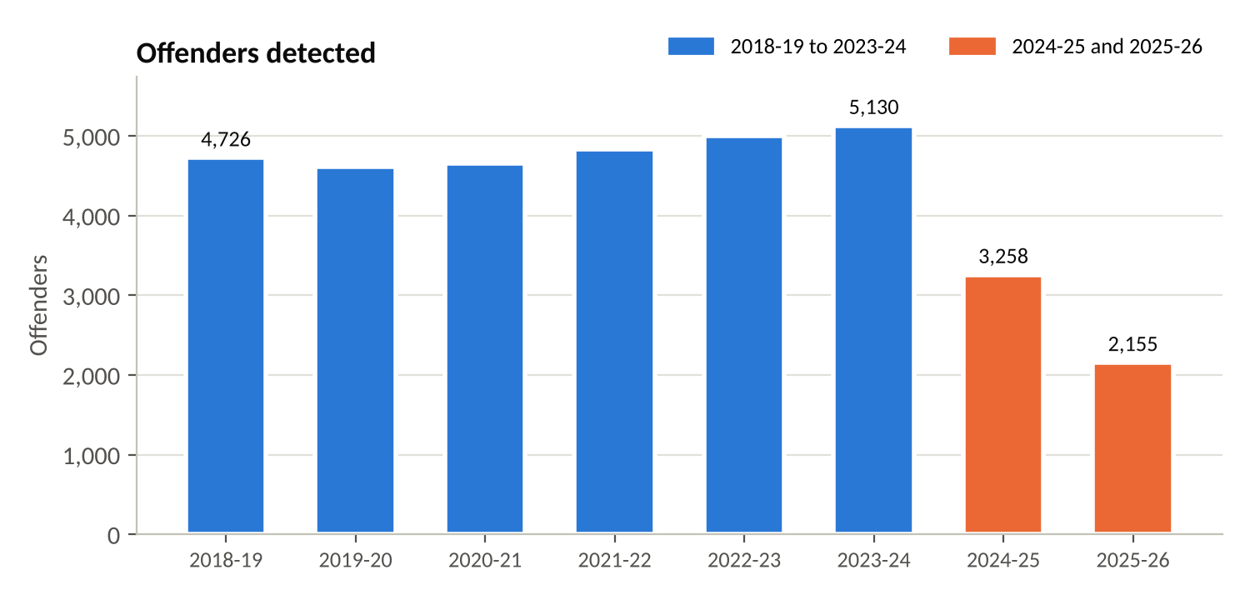
Offenders detected rose gradually to a peak of 5,130 in 2023-24, then fell to 2,155 in 2025-26. This does not mean fewer people are breaking the rules. With far fewer inspections, far fewer offenders are being found. The compliance figures below show that offending as a share of those checked has risen.
How offences are dealt with
Until 2024-25, the mix of outcomes was stable: roughly a third infringement notices (fines), around 40% official warnings and about a quarter verbal warnings. In 2025-26 that changed sharply. Fines fell to 10% of outcomes, and verbal warnings rose to 62%. The number of verbal warnings rose by 69%, from 1,687 to 2,854, even though far fewer people were checked.
Prosecution briefs, used for the most serious cases, have stayed fairly steady at 20 to 52 a year (35 in 2025-26). This fits the Government’s stated focus on serious fisheries crime. However, everyday enforcement on the water, which deters most offending, has fallen away.
Fewer people are being checked, and those caught breaking the rules are far less likely to be fined.
4. Compliance and the 90% claim
In 2025, VFA Chief Executive Travis Dowling cited a compliance rate above 90%, on ABC Country Hour, as the rationale for reducing Fisheries Officer numbers. The VFA’s published overall compliance figures cover the same inspection categories as that claim, excluding marine safety, so the two can be compared directly.
On the VFA’s own published figures, compliance was above 90% in only one of the last eight years, at 91% in 2018-19. From 2019-20 to 2024-25 it sat at 88 to 89%. After the cuts, it fell to 85% in 2025-26. In other words, about one in seven fishers checked was breaking the rules.
The figure used to justify the cuts does not match the VFA’s own published data. Since the cuts, compliance has worsened.
What this means
• Marine protection: with marine park patrols more than halved, no-take sanctuaries are left largely unwatched, at the same time as new sanctuary areas are being declared.
• Marine safety: more than 6,000 safety inspections a year have stopped, including on the Bay and on inland waters.
• Fish sustainability: fewer checks, fewer fines and falling compliance mean more illegal and undersize take goes undetected. Fewer inspections also means less data for managing fish stocks.
Questions the VFA and the next Government should answer
• Why did inspections in every category begin falling in 2024-25, before the 2025 restructure?
• Who decided that marine safety inspections would stop, and what has replaced them?
• Why have fines fallen from about a third of enforcement outcomes to one in ten? Was there a change in enforcement policy?
• Offences recorded per offender detected rose from about 1.1 to 1.2 in earlier years to about 2.1 in 2025-26. What explains this change?
• How will the Jawbone Marine Sanctuary extension, and existing sanctuaries such as Ricketts Point, be enforced with 61% fewer marine park patrols?
• Will the next Government restore Fisheries Officer numbers to at least the 73 in place before the 2025 restructure, and reinstate marine safety inspections?
About the data
• All inspection, patrol and enforcement figures are as published by the Victorian Fisheries Authority on its website, for financial years 2018-19 to 2025-26.
• The compliance rate is the VFA’s published overall non-compliance figure subtracted from 100%. It excludes marine safety inspections.
• Enforcement outcomes (warnings, infringement notices and prosecution briefs) are counted per offence. One offender can commit more than one offence, so outcomes exceed the number of offenders detected.
• Percentage changes and shares are VFPAI calculations from the published figures.
Contact
Paul Millar, Spokesperson, Victorian Fisheries Protection Alliance Incorporated